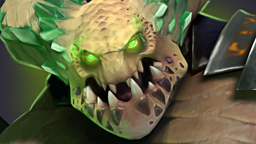
Underlord
Underlord is a melee strength hero in Dota 2, played as support, nuker, disabler.
Base stats
- Attack range
- 200
- Attack type
- Melee
- Base armor
- 3
- Base attack
- 37–43
- Move speed
- 290
- Primary attribute
- Strength
Derived
Weakest matchups
| Ursa | 37.2% ±6.5 | n=145 |
|---|---|---|
| Phoenix | 38.1% ±6.8 | n=134 |
| Clockwerk | 40.0% ±7.3 | n=120 |
| Largo | 40.3% ±7.3 | n=119 |
| Dawnbreaker | 40.9% ±7.6 | n=110 |
| Rubick | 41.0% ±6.0 | n=178 |
| Hoodwink | 41.1% ±5.4 | n=219 |
| Slardar | 41.4% ±6.2 | n=169 |
| Pudge | 41.7% ±7.9 | n=103 |
| Snapfire | 42.4% ±6.4 | n=158 |
| Windranger | 42.6% ±6.5 | n=155 |
| Shadow Demon | 43.0% ±6.6 | n=151 |
| Shadow Fiend | 44.6% ±5.2 | n=249 |
Win rate by bracket
| Herald | 50.9% | n=2,821 |
|---|---|---|
| Guardian | 50.2% | n=10,807 |
| Crusader | 49.9% | n=23,695 |
| Archon | 49.2% | n=42,706 |
| Legend | 47.6% | n=51,607 |
| Ancient | 46.5% | n=28,696 |
| Divine | 46.0% | n=16,287 |
Skill bracket skew
| Herald → Divine | -4.9 pts — weaker in higher brackets |
|---|
Analysis
Underlord is the clearest counter-example on this site to the idea that a matchup table and a bracket curve tell different stories. Here they tell the same one, loudly.
The win rate falls from 50.9% in Herald to 46.0% in Divine, dropping below fifty by Crusader and continuing down without recovery. That is a 4.9-point decline. Meanwhile thirteen pairings clear the significance test against Underlord and not a single one clears in its favour. Among the heroes that measurably beat nobody, it is the most comprehensively beaten — though not the most beaten overall, since Mars carries fourteen unfavourable results while also winning some.
The list of thirteen is instructive because of how varied it is. Ursa takes Underlord to 37.2% and Phoenix to 38.1%, then Clockwerk, Dawnbreaker, Rubick, Hoodwink, Slardar, Pudge, Snapfire, Windranger, Shadow Demon and Shadow Fiend all land between 40% and 45%. Melee initiators, ranged supports, mobile cores, spell thieves. There is no single archetype to avoid here, which is unusual — most heroes with long unfavourable lists are losing to a recognisable type.
Compare this with Sniper, which has the opposite profile: nothing in the dataset measurably beats Sniper, and it declines anyway. The conclusion there was that its weakness was a competence rather than a counter. Underlord is the mirror image. Its weakness is a counter, thirteen of them, drawn from across the roster, and the bracket curve simply reflects how reliably opponents find one.
The same picture appears from the other direction, which is a useful confirmation. Look across all 127 pages at which heroes turn up most often on somebody else’s favourable list — that is, which heroes other people reliably beat — and Underlord is second, appearing on thirteen of them, behind only Mars at fourteen. It appears on nobody’s unfavourable list at all. Underlord is not merely losing its own matchups; it is one of the two most dependable things to be matched against in the game.
The sample is thinner than the big-population pages — 176,619 games, with 16,287 at Divine — and the individual matchups carry five to eight points of margin. The pattern across thirteen results pointing the same direction is considerably firmer than any one of them, and it is the pattern that matters.
Related
Sources
- OpenDota retrieved 2026-10-24
Game data version opendota-2026-10-24